
Life, Liberty, and the Pursuit of… Goods?
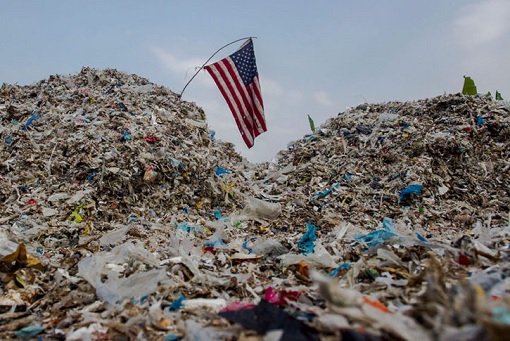
With consumerism deeply embedded in American culture, looking at the United States’ consumption is like looking through a magnifying glass to see what our world is about to become.
8 minute read
Those words “life, liberty, and the pursuit of happiness,” written in the Declaration of Independence, are celebrated by millions of Americans each July 4th. In 2019 alone, this meant one billion dollars spent in beer, five million in US flags, and 150 million hot dogs eaten. Patriotism is profitable in America. Corporations used this idea of patriotism and sense of identity in their advertisements to sell their products in the 1950s and 1960s.
The “pursuit of happiness” is believed to be accessible through consumption, as advertising convinces people it will resolve all their challenges. The impact of advertising in the United States should not be underestimated: the US is the largest advertising market in the world. In 2016, US companies spent a total of $190 billion in advertising, which is twice as much as the amount spent in China – the second largest ad market. The thrill of the purchase only lasts a few days, though, which leads to even more purchases and ultimately getting stuck in the spiral of earning and spending. Shopping does not lead to happiness – many times, it leads to the opposite. As Charles Derber explains, many people feel exhausted trying to keep up with the latest trend and are under the impression that their lives will never be fulfilled. Today, corporations define the idea of what a good life is and what one needs to possess in order to find happiness. Corporations encourage people to consume in excess of their needs and their accounts. According to the US Department of Commerce, American’s personal savings rate has decreased since 1982, from 11 percent to below zero. Debts have become normalized in the US. The average American credit card holder has at least four cards, and on average, each household with a credit card carries $8,398 in credit card debts. Although this decrease in savings can be explained by other factors – such as the rise of tuition costs – it is a consequence of a growing consumerism. The deregulation of credit cards’ interest rates in 1978, which allowed the credit card industry to enlarge its clientele to younger and poorer people, is also a factor. Debts often lead to unhappiness, as financial difficulties are the leading cause of marital problems among Americans. In order to keep up with consumerism, many people have to work longer hours and during the weekend. This results in people spending less time with their family and friends, often leading to stress and depression.
Creating one’s own identity and style is thought to be one way to achieve “liberty.” However, this is often done through purchasing products. People tend to think they are freely creating their own image, but they are aspiring towards the image corporations have decided for them. In order to be free to invent themselves, they do what somebody tells them. This is contrary to the ideas about freedom and individualism the famous American essayist Ralph Waldo Emerson advocated for. In his 1841 essay “Self-reliance,” he writes, “Whoso would be a man must be a nonconformist,” and he went as far as to say, “Envy is ignorance, imitation is suicide.” Today, consumerism leads to the conformity Emerson loathed. The same products are being purchased, and the only way to be different is by buying other goods. As everybody purchases, everybody is a conformist. It can be argued that conformism is not utterly wrong. However, it is wrong, when it is not a choice someone takes the “liberty” of making by himself.
Consumerism is not only tied to the fundamental idea of “life, liberty, and the pursuit of happiness,” but also to the American Dream. As the term came to be used in advertisements by home builders in the 1970s and 1980s, the American Dream became tied to the idea of social mobility and material prosperity. As consumerism developed, success began to be determined by the quantity or quality of goods one owns. This is what Thorstein Veblen calls conspicuous consumption: people tend to buy goods to prove their social status more than for their utility.
As consumerism is part of American culture, it increasingly dominates Americans’ lives. This can be understood through some figures: in 2017, $240 billion were spent on products such as jewelry, watches, luggage, books, and phones – twice as much as in 2002. The American population only grew by 13 percent during those years. Consumerism increased with the start of outsourcing to countries with lower labor costs. People do not think twice about buying these cheaper products. However, these products are often of poorer quality, which leads to a decrease in their life expectancy, thus generating even more purchases. Americans buy 20 percent more clothes than they did in 2000, with the average American buying 66 items of clothing a year. This excess resulted in the average square footage of houses to increase by 23 percent in the last two decades and the number of storage facilities to double, even though the average American family size decreased. Today, goods tend to have less value in people’s eyes. However, this does not push them to buy fewer products. Last year, Americans beat a record by spending $7.4 billion in online sales during Black Friday and $9.4 million during Cyber Monday.
This has a huge environmental cost. The US represents four percent of the world’s population but produces 12 percent of municipal solid waste. In comparison, China and India account for 36 percent of the world’s population and generate 27 percent of waste. For a long time, the US has sent their waste to China. However, now that China has restricted imports of some recyclables such as mixed papers or most types of plastic, waste has become an issue in the US. Indeed, the problem lies within the price of recycling: for many municipalities, it is cheaper to throw things away than to recycle them. For many companies, it is cheaper to use new material than recycled one. Indeed, the US is quite late in terms of recycling: they recycle 35 percent of their municipal waste, when Germany – the most efficient country in terms of recycling – recycles 68 percent.
However, consumerism is not solely an American issue. It is deeply embedded in the American culture, but consumerism is spreading and increasing all around the word, resulting in a high environmental cost. In France, the waste generated per capita – the kilograms of waste produced per person – was 514 kg in 2015. In the United Kingdom, it was 412kg in 2016. In comparison, the US – which is the biggest generator of waste – produces an average of 808 kg per capita, which is twice as much as Japanese citizens. In 2018, the World Bank stated that at this pace and without action, global waste would increase by 70 percent by 2050.
Taking a step back and slowing down our consumption is urgent and essential both for our well-being and the planet’s. So, how to get excited about buying fewer things? Firstly, by rekindling our love of things. By buying fewer products, we would appreciate what we have and the few purchases we do make. We can also do this by buying better. Buying a fair-trade product, for example, would make us value it from an ethical point of view – and for its better quality. Our consumer behavior has a political leverage. It can be literally political, such as when people chose to boycott Trump-branded hotels, or it can be for another thing you believe in, such as not buying products with palm oil or from companies who do not respect labor laws. We can do big things with small choices and there are plenty to make. Many choices have actually become trendy such as minimalism, fair-trade shopping, and personal challenges like zero-waste households, capsule wardrobes, and one year without shopping.

We must all take a step back and be aware of the constant intrusion of ads in our personal space. Advertisements are constantly here – even when the world is falling apart: did you notice that every big ad screen on Times Square is still on when New York City is on lockdown due to Covid-19? Times Square uses 161 megawatts of power at once, which is enough energy to power 161,000 average US homes or about 60 percent of the electricity required to power all Google services (search, Gmail, YouTube, etc.) around the globe. This suggests how important advertising and consumerism has become in our world. Now, it is our duty to be aware and think critically: how many times per day are you exposed to advertising in any forms? Why do you want to buy this product? Who/what created this desire? How will it make you happy? It is time to take our freedom back.
“For what avail the plough or sail,
Or land or life, if freedom fail?”
– Ralph Waldo Emerson
 PLUTO
PLUTO 
Leave a comment